
Craving a cherry pie, but what you have are sweet cherries? Read on. Also, check out the update at the bottom of the post.
Every year, same story. Those pesky pests (squirrels, raccoons, blackbirds) beat us to the cherries before we can enjoy even a handful. Earlier this year, we began scheming how we could beat those rascals to the punch.
Yesterday morning, after chasing 6 blackbirds out of one cherry tree, I made a call in my house for all hands on deck. The family joined me to pick all of the reddish cherries we could find. We left the yellow and barely peachy ones on the tree, but got a bucket full of the red, but unripe ones. (These cherries would normally be dark red when ripe, like a Bing cherry.) When picked underripe, the cherries are not as sweet and a bit shy of flavor.

To combat the difference between unripe sweet cherries and fully ripe tart cherries, I added lemon juice, sugar, and almond extract.

Yesterday morning, after chasing 6 blackbirds out of one cherry tree, I made a call in my house for all hands on deck. The family joined me to pick all of the reddish cherries we could find. We left the yellow and barely peachy ones on the tree, but got a bucket full of the red, but unripe ones. (These cherries would normally be dark red when ripe, like a Bing cherry.) When picked underripe, the cherries are not as sweet and a bit shy of flavor.

To combat the difference between unripe sweet cherries and fully ripe tart cherries, I added lemon juice, sugar, and almond extract.
After lunch, I set out to pit and use these cherries. For this pie, I decided on an open-faced one. Cherries meant for eating fresh tend to be quite juicy, so a pie without a top crust would allow for evaporation of liquids. I added sugar, lemon juice, and almond extract until the flavor was just right. The lemon juice gave the cherries the tartness they needed while the almond extract boosted the cherry flavor.
To about 8 cups of pitted cherries, I used 3 tablespoons lemon juice, 3/4 cup of sugar, and 1 1/2 teaspoons almond extract that gave cherries enough for 1 full pie just the right flavor. I also tossed the cherries with 2 tablespoons of cornstarch to help thicken the juices. In hind sight, I would increase the cornstarch to 2 1/2 to 3 tablespoons for thickening.
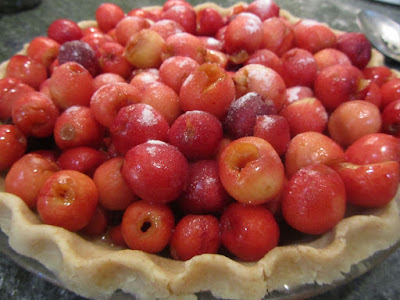
This is how full the pie pastry was before baking, to give you an idea of how many cherries will yield a full pie.
I baked the pie at 425 degrees F for 15 minutes. Then I reduced the temp to 350 degrees F and baked another 30 minutes. At this point, the crust and some of the cherries were browning, so I covered the pie with an inverted pan (our skillet which has lost its handle was just the right diameter and depth) and baked for another 15 minutes.

After baking, this is how much the cherries "shrunk" down.
The family agreed -- this pie was absolutely delicious.
There are enough of the ripening cherries for me to do this one more time later this week, if we can keep those pests out of the tree.
Making the most of what we can get from our garden this year.
To about 8 cups of pitted cherries, I used 3 tablespoons lemon juice, 3/4 cup of sugar, and 1 1/2 teaspoons almond extract that gave cherries enough for 1 full pie just the right flavor. I also tossed the cherries with 2 tablespoons of cornstarch to help thicken the juices. In hind sight, I would increase the cornstarch to 2 1/2 to 3 tablespoons for thickening.

This is how full the pie pastry was before baking, to give you an idea of how many cherries will yield a full pie.
I baked the pie at 425 degrees F for 15 minutes. Then I reduced the temp to 350 degrees F and baked another 30 minutes. At this point, the crust and some of the cherries were browning, so I covered the pie with an inverted pan (our skillet which has lost its handle was just the right diameter and depth) and baked for another 15 minutes.

After baking, this is how much the cherries "shrunk" down.
The family agreed -- this pie was absolutely delicious.
There are enough of the ripening cherries for me to do this one more time later this week, if we can keep those pests out of the tree.
Making the most of what we can get from our garden this year.
Update 2026: Since baking I began baking our unripe sweet cherries into pies, I've settled on a new method for handling the cooking and flavoring of the cherries. I now pre-cooked the filling in a saucepan early in the day or the day before baking the pie and use a double crust. I use the same measurements of filling ingredients, but also added 1 tablespoon of water to account for evaporation while cooking the filling.
Here's my recipe:
Two-Crust Unripe Sweet Cherry Pie

8 cups pitted under-ripe sweet cherries
3/4 cup sugar
2 1/2 to 3 tablespoons cornstarch
2 1/2 tablespoons lemon juice
1 tablespoon water
1 1/2 teaspoons almond extract
pastry for double crust pie
In a medium saucepan, stir together the cherries, sugar, cornstarch, lemon juice, and water. On medium heat, bring to a low boil while stirring. Continue stirring until mixture has thickened and appears more translucent, less cloudy.
Remove from heat and stir in almond extract. Allow to cool fully before filling pie pastry.
Fill and vent the pie pastry in a 9-inch pie plate.
Bake at 400 degrees F for 20 minutes. Reduce oven to 375 degrees F and bake for 35 to 37 additional minutes, until crust edges are browned.
You'll notice that I don't make a lattice crust. That would take additional time. Instead, after fitting top crust onto pie filling and crimping the edges, I use a sharp paring knife to cut four leaf shapes out of the top unbaked pastry, then place these pastry leaves in between each leaf-shaped vent. This is a much easier and quicker way to vent a cherry pie.
If you enjoy reading about alternative methods for making pies, you might want to check out my recipe for Old-Time Lemon Meringue Pie. this recipe does not use cornstarch or cream of tartar.


