Stay Connected

Tuesday, July 16, 2024

Today on the farm . . .


 . . . we finished harvesting all of the cherries. 

We've been picking daily for the last week. Each day, we'd pick a dishpan or two of cherries, then my daughters and I would pit them all. Today was our last day, and I'm rather relieved. As I usually do, we left a few cherries on the tree for the squirrels, raccoons, and birds. I like to give them just one last taste before they have to find a new source of food.

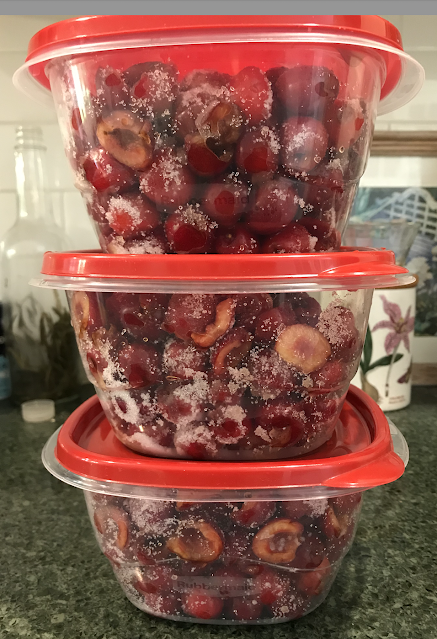
So here's our total: 4 jars of cherry preserves, 1 pint of candied cherries, 3 jars of cherry syrup, 3 cherry pies, and 22 quarts of frozen pitted cherries for cooking later in the year. We also have 4 quarts of fresh cherries in the fridge right now, and we've been eating fresh cherries as a fruit for the past week. Fresh cherries, pitted and halved are delicious on salads. Today I made a large salad for lunch -- greens topped with cheese, chopped nuts, quinoa, and fresh cherries. I dressed it with a blackberry vinaigrette. Very delicious, and it felt so gourmet to have fresh cherries on our salad.

This is an absolute record for us. The local weather forecaster said this would be a bumper cherry crop for our area, and he was spot on.

I never thought it would be possible to get tired of eating fresh cherries daily.

Monday, July 15, 2024

A One-Year Compost Pile


I've mentioned before that we compost using two different compost bins. The first one is a straight-sided, rest on the ground, open to the dirt beneath plastic bin. It takes about a year to completely fill. I layer yard and kitchen waste with cardboard and paper. I don't follow precise ratios, but instead try to remember to add some paper and cardboard from time to time.

The above photo is just after lifting the plastic bin off of the pile after one year of filling. The pile is about 3 X 3 feet. I've moved the bin to a new location, so we can improve the soil there.

After one year you can still see some paper and cardboard in the layers, as well as some dried stalks from plants. I'll begin to turn the pile over into an adjacent bare spot to improve decomposition sometime this summer, when I have more time of course. As material breaks down, the pile shrinks.


In the meantime, I can access some good composted material from the bottom. I have dug out a couple of gallons of compost to amend soil when planting some perennials and shrubs this spring and summer. I simply dig away at the bottom edge of the pile where everything is pretty well decomposed.


Occasionally someone in the household will add something to the compost that is only partially compostable. Here's the plastic lining from a take-out paper coffee cup. All that is left is the plastic. The paper part is long gone. I pick these bits out when I come across them when digging. In a perfect world, my family would remember that these cups don't go into the compost but are better set aside for fire starters in the outdoor fire pit. It does make you think, though, right? When we get a takeout coffee, our tasty hot beverage is steeping in a plastic-lined cup. That can't be good for us. 

We've had the same plastic compost bin for 25 years. It's cracked and chipped, but still does a good enough job holding material in a heap. The pros- it was inexpensive. We bought it through a community program, paying about $10. It's great for bulky items like complete plants at the end of the gardening season. I pile whole tomato plants into the bin. Because it's open at the bottom, worms quickly get to work. Cons-also because it is open at the bottom, critters can dig into it from underneath. Also, as the material only gets turned after a year, it takes longer for it all to decompose. All in all, we're pretty happy with this composter.

Before we bought this one, we had an open heap behind an evergreen tree away from the house or boundary with our neighbors. The heap did work, but we had problems with critters digging in there and making a mess.

Our other compost bin is a tumbling one. I'll tell you more about that one, and what we think another time.

Do you compost? What type of bin do you use? Does your material breakdown faster than it does for me?

Thursday, July 11, 2024

The Purple Chair

I think the garden is a great spot for a bit of whimsy or surprise.  

This wooden chair was formerly sage green, then white, and now I've painted it purple to tie in with the purple blooms of my lavender container garden. The large right lavender is just now in bloom. If you look closely you can see the purple blossoms.

I used spray paint, Rustoleum 2X Grape, gloss and top-coated with Rustoleum 2X Clear, semi-gloss. I chose the shade of purple that I wanted while in the store at Home Depot, comparing the color on the can to an actual English lavender plant beginning to bloom in the garden center there. Grape was practically the exact shade of purple. I'm sure I must have looked a bit silly holding cans of spray paint up against the potted plant.

It took 1  2/3 cans of the purple spray paint and just a little from the can of top-coat that I had from a project last year. The entire painting part took 3 days.

Anyway, purple may be an unconventional color for a chair. But I think it looks lovely in the garden next to the white pots of lavender.

Wednesday, July 10, 2024

It's a battle for the sweet cherries in our yard, but I'm making the most of it


Every summer it's the same battle. The squirrels, raccoons, and blackbirds want our cherries before they're fully ripe for our family's fresh eating. We do get to eat some of the cherries ripe and sweet off the tree. But also, I've gotten creative in using the cherries before they ripen and get snatched by the critters. 

a bit of a rustic looking cherry pie

This week I made cherry pie using underripe sweet cherries, lemon juice, corn starch, sugar, salt, and almond extract for the filling. 

more cherry pie filling to use in another pie this week

One trick I've learned about making pie with sweet cherries is to cook the filling in a saucepan before pouring into a pie crust. Sweet cherries tend to have a higher water content than sour cherries. So cooking some of that water out in the saucepan helps the pie cook evenly, fully cooked filling that's not at all soupy and crust that is golden brown. The pie was a hit and lasted 2 days in our house. I made another batch of pie filling yesterday, and I will bake it into a second cherry pie for tomorrow's dessert.

candied cherries

Today I made a batch of candied cherries, following the instructions from this site. Overall, I think they turned out pretty good. The next time, though, I'll use less water to begin (maybe 2 1/2 cups instead of 3), as it took a long time for the liquid to thicken to syrup consistency and thus candy the cherries. I felt the cherries came out slightly overcooked as a result. I suppose the site's author used a larger saucepan than I did, and that would've cooked the liquid out faster. Anyway, I am pleased with the cherries. 


Four cups of fresh cherries yielded two cups of candied cherries plus about 6 ounces of surplus syrup. I'll freeze the candied cherries and use them at Christmas in fruitcake and to top Swedish spritz cookies. I'll be using the surplus syrup on waffles later this week.

Tomorrow I plan on making cherry preserves. In years that we get a good crop of cherries, I make Bonne Maman style cherry preserves. These preserves are not only delicious on toast or muffins, but they make a nice topping for ice cream sundaes or filling for cakes. 

My fingernails are so badly stained from pitting so many cherries this week. Fortunately, I don't have any place special I need to go. I guess that's a price I'm willing to pay. Terrible looking fingernails in exchange for tasty cherry treats made with organic and very locally-sourced cherries.

Tuesday, July 9, 2024

Saving On Expensive Dental Products

image: pixels.com

In some ways, saving on dental products is a lot like saving on other items you might buy for your home or personal consumption. Comparing prices, using coupons, signing  up for emails, buying less expensive versions or brands are all techniques used for both dental needs and "regular" products. The difference between dental recommendations and say food or home furnishings purchases is that dental products are a lot more like medical products. If your physician recommended that you take a specific rx, you wouldn't try to DIY it at home. The same goes with what your hygienist or dentist may recommend. In contrast, I can very easily make my own ketchup or grow my own vegetables and not only cause zero harm to myself, but may actually increase my nutrient intake. I can also buy furniture second-hand with no ill effects. Not the same with most medical and dental recommendations. I can't manufacture my own dental floss or fluoride toothpaste in the basement. And I don't think it's prudent to buy an electric toothbrush or water flosser second-hand at the thrift store.

All of that said, there are ways to save a lot of money on the products and equipment that you need to keep your teeth and gums in good condition. For myself, I estimate that I have saved 30% to 40% on my dental product purchases by following these tips.

If you're one of the lucky ones who inherited a great mouth of teeth, then you may not need any of this. For myself, I come from a long line of family who no matter how hard they try to care for their teeth, they still have a mouth full of issues. So these tips are really for those who have received recommendations for specific, costly products and tools just so they can hang onto their natural teeth or avoid painful procedures down the road.


with your hygienist

  • ask if there's a less expensive, but equally effective alternative
  • ask for samples at every visit
  • ask for coupons or coupon codes for ordering online
  • if your hygienist is recommending that you purchase everything under the sun, ask why. In my case I asked about mouth rinses. My hygienist was honest with me and told me I didn't need a commercial product, but I could use a baking soda and water rinse to alter the ph in my mouth.
  • if an electric toothbrush is recommended, and this isn't in your current budget, ask your hygienist for cleaning tips using manual toothbrushes. It may take a combination of 2 different manual toothbrushes to get your teeth thoroughly clean. 
  • don't be passive in the dental chair but ask for tips on how you can do better. I think of my hygienist as more of a coach and less of a judge, if that is helpful to you.
in use at home
  • measure amounts used every time -- if toothpaste says pea-sized, eyeball a pea-sized amount, if floss says 15-18 inches, find something handy to the sink that is that length to measure against. I use the mirror above the sink to measure my floss, holding the string up to the mirror before cutting. If a recommended mouthwash calls for an amount by ounce, find a cup that measures that amount and use that cup every time.
  • use every last bit. this is the tip that most of us already follow when it comes to toothpaste. We flatten and scrape tubes, cut open tubes, and rinse tubes to get every last bit.
purchasing online
  • if product is only available online, compare prices between manufacturer "store" on website and Amazon or Walmart.com.
  • sign up for email and text alerts to get initial introductory discount from manufacturer website
  • take advantage of periodic sales, usually announced through texts and emails, stocking up as affordable
  • buy in bulk, such as multi-packs to get a bit of a discount
  • buy at least the minimum amount required to get free shipping every time
  • price compare "subscribe and save" option to ordering on your own in your time. Amazon's "subscribe and save" offers 5% discount on initial purchase and 10% on subsequent subscription purchases of 5 or more of the same items. In contrast, I can save 15% off of the same base price through the manufacturer's website by waiting for a sale (notification by text and email). I save an additional 2% by buying a multi-pack bundle (and it qualifies for free shipping). So, my savings by skipping the subscription saves me 17%, whereas the best case with Amazon's subscription service is a 10% savings. (BTW, I've been advised to use a rather expensive toothpaste. So this works out to be a good savings for me.)
purchasing locally
  • if the product can be purchased locally, obviously compare prices between stores, use coupons, and buy when on sale.
dental floss
  • even if you're buying plain old regular floss, consider shopping online at either Amazon or Walmart.com. You can often find larger spools of floss online than you can in local stores. And beyond that, online you can find refill spools of floss. Compare the price per foot between the small and large canisters.
  • There's a hidden savings in buying a large refill spool or a large canister of floss. At the end of every small container of floss, there's always that last short bit of floss that is too short for a complete cleaning. I usually end up throwing these short pieces away, unused. Larger spools of floss will mean that you come across that short end fewer times in a year compared with multiple small containers of floss.
  • many of the newer eco-friendly or specialty brands of floss offer refills for their individual canisters. While you don't get big savings from buying a super large canister or refill, these smaller manufacturers do offer a discount when buying simply the refill (that you would then place in the holder) as opposed to the holder with floss. When searching in an online store, add the word "refill" in the search field.
night guards
  • over the counter night guards that you fit yourself cost $20 to $30. Pros- cheap and quickly obtainable. Cons-they wear out more quickly than those provided through your dentist and need replacement. OTCs are also a one-size fits all product that is then molded to your bite. If you happen to have an unusually large or small jaw, the OTC may not fit properly.
  • custom fitted night guards provided through your dentist can cost upwards of $200. Some dental insurance carriers will pay part of this cost. However, there is usually a coinsurance payment required. Pros-you know they will fit exactly to your bite, plus they tend to last longer than OTC night guards. Cons-they are expensive and take more time to replace when they do break down, crack or develop a hole.
  • whether buying over the counter or through your dentist, most dentists recommend replacing night guards every 3 to 5 years, or sooner if they break down. So this isn't a once and done cost to consider.
electric toothbrushes
  • both my dentist and my daughter's dentist recommended we buy the low-end big name brand electric toothbrush but buy off-brand replacement heads. The savings on off-brand replacement heads is substantial. For example, on Amazon you can buy a 4-pack name brand replacement head for $22.50, a price of $5.63 each head. Alternatively, you can buy a 10-pack off-brand for $16.96, a price of $1.70 each head. The ratings on both the name brand and off-brand are comparable. Even if the off-brand head wore out twice as fast as the name brand, you would still save almost 50% on your replacement head costs.
  • as for buying the low-end big name brand of electric toothbrush, these models typically have just one or two settings and need more frequent charging. For my mouth, my hygienist agreed that I only needed two settings (1 gentle, 1 regular cleaning). And for my convenience, I plug my toothbrush in every night, so it always has a full charge.
water flossers
  • I've had the same Waterpik for 10 years. I bought a low-end model at a local big box store, on sale and using a coupon. It still works as well as it did when new. 
  • maintaining a water flosser will extend the life of your unit significantly and save its replacement cost down the road. The 2 problems that would make a Waterpik completely unusable (and that you can prevent) would be with the pump motor if it were damaged through contact with water or mold, bacteria, or mineral deposits inside the reservoir or tubes and hoses. The first is simple. Just keep the motor unit itself out of water. Keeping it free of mold, bacteria or mineral deposits requires a little more attention. Empty completely after each use. My model holds just enough water for one use. After each use I empty the reservoir into the sink. Since the spaces inside the tubes and hoses is not visible to the user, I also empty the hoses completely after each use by holding the reservoir above the dental pick end and allow all of the water to run out of the hose into the sink. A little moisture might remain inside the tubes or hoses. To combat mold and bacterial growth in those areas, I run about 3 capfuls of hydrogen peroxide diluted in 1/2 cup of water through the machine and into the sink every other Saturday. Alternatively, you can use a 2:1 ratio of white vinegar to water. (The vinegar approach will also tackle mineral deposits if you have hard water.) I follow this cleaning rinse with a reservoir of plain water. Air dry thoroughly. After each use I detach the reservoir from the motor unit and allow the area where these two parts meet to dry between uses. Once a month wash with soap. I hand wash the reservoir (detached from the motor unit) and the wand and tip using liquid dish soap once a month. I also remove and clean the rubber valve at the bottom of the reservoir. Note: some wands contain a battery and can't be immersed. Know which type of wand your model uses and clean that part according to manufacturer's directions. This all sounds more involved than it really is. For more information on cleaning a water flosser, see this wikihow.
  • if you buy a big name-brand water flosser, replacement parts for some elements are easily purchased online. Here's Waterpik's replacement part listing with links to trouble-shooting a couple of issues.
I'm on the fence when it comes to tongue scrapers. I currently brush my tongue with my toothbrush after doing my teeth. One study I read indicated that while scraping your tongue can reduce bacteria in your mouth, tongue scraping didn't reduce plaque formation on teeth. And yet another study indicated that scraping your tongue and/or brushing your tongue can reduce plaque. I'll have to ask my hygienist when I see her later this month what she has read on tongue scrapers and plaque.


Monday, July 8, 2024

Our 4th of July Celebration


For those of you in the US, I hope you all had a wonderful 4th of July weekend. Actually, I hope everyone had a wonderful weekend, in the US or not. 

Our family gathered for a very fun day at home, so much fun it took a couple of days to recover! What can I say? We're patriotic people and like to celebrate our country's independence to the best of our resources.


My daughters gave me a gift card to Dollar Tree for my birthday last year, so I could pick up more frivolous things without guilt. I used some of its value to buy a bunch of small American flags and these patriotic dinner napkins. There were 25 napkins in the package. So I put the rest away and now have napkins for a few future 4ths of July.

The flags have plastic sticks, so they're perfect for popping into flower pots. And the flag part is plastic. I bought 2 packages of 3 flags/package. I'll put these away for future 4ths, too.


Another patriotic decor item came from a free pile this past winter. One of our neighbors put a box of  red and blue outdoor string lights out with a "free" sign back in February. Of course I picked it up. My family helped me hang a couple of strands along the deck railing and up into the trees on the 3rd.  The lights were festive and cheery in the background. The other great thing about this freebie is I will be using the strand, subbing orange bulbs for the red and blue, in the fall for Halloween. My other strand shorted out, but the light bulbs are still good.

We had perfect weather for the day, mildly warm at midday just as our neighborhood 4th of July parade passed by. My artist daughter set up a table and small easel at the driveway's edge and drew caricatures for anyone who wanted one. We had a couple of chairs set up, making our little part of the neighborhood a bit of a gathering spot. As a bonus, my daughter got hired for a caricature gig over the weekend as a result of her work on the 4th. She hires out to do caricatures at parties to earn a little extra money on the weekends.

After the parade our little foursome retreated to the backyard for a picnic on the lawn in the shade. As the afternoon began to heat up, we headed indoors to put together our 4th of July dinner.

Our son and daughter-in-law came overrun time for a cookout, yard games, and lots of fun fireworks. The menu for the cookout included a variety of hot dogs and sausages cooked on sticks over a fire, buns, sweet potato fries, potato chips (leftover from lunch's picnic), a slaw-type salad, raw vegetable platter, fresh cherries, fresh papaya (provided by my son and daughter-in-law), a cherry pie/jello/pretzel crust/sour cream dessert, lemon bars (leftover from lunch), and s'mores. It was a delicious dinner and dessert and an enjoyable time sitting around the fire ring.

After our own fireworks, the 6 of us took a late night walk through the neighborhood to watch our neighbors' fireworks displays. We tend to spend modestly on fireworks. However, a few of our neighbors go all out and put on pretty spectacular displays. One display went on until just before midnight. Around 1 AM we finally made it to bed.

We had such a fun time together. But now it's time to get back to work. 

Did you do anything fun for the 4th or over the weekend?

Tuesday, July 2, 2024

When you're going through a "tired" phase in your life -- 10 tips

Tired periods in life can be precipitated by illness, injury, surgery, grief, stress, loss or even those "happy" moments such as adding a child to the family or excelling in one's career or education. We all have those phases at some point. My own tired phase this go round is primarily due to my recent surgery. To deal with this, I compiled all of the advice I've been given in life and my own previous experience to come up with a list of 10 "rules" for myself.

Obviously, these suggestions only apply to responsibilities that are not part of paid employment. Beyond taking sick leave, most employers have only so much patience for an employee who performs well beneath their usual level for a prolonged period. My rules are more for how to deal with home responsibilities during a challenging phase.

Here they are:

  1. Make physical contributors to recovery (those that boost health, such as sleep, water, good food, and sunshine) a priority. This is not the time to stay up late watching movies night after night or binge-eat a box of cookies or bag of chips. I've had to be more disciplined than normal and opt for a bowl of brown rice and garden greens for a snack in place of crackers more than once these last couple of weeks. I will say, however, that it's also important to allow yourself a treat here and there. Eating food that is pleasing lifts spirits, and that in itself is healing.
  2. Lean into the responsibilities that you enjoy most or have the most ability for. For me, this would be cooking. I enjoy cooking and feel accomplishment when I've baked cookies or made a good lunch for the family. For others, this might mean doing basic cleaning, organizing tasks, or garden work. I've never enjoyed cleaning the house as much as I do baking. These last 2 weeks I've spent many of my work hours baking cookies, snack cake, bread and cheese strata, and mixing up a small batch of frosting for some lingering plain cupcakes that my daughter had baked. I feel productive. I am taking care of my family in this limited way. And I'm slowly reintroducing regular life back into my days.
  3. Take the easy route with the jobs that you like less. This might mean spending a bit of extra money to buy cleaning supplies that do more of the work for you, or buying a few more convenience food products for daily meals. It might also mean using the vacuum on the kitchen and bathroom floors in place of a broom and skip the mopping for a week or two or three. Dusting tools abound and are real time-savers compared to a rag and spray. Heating a healthy frozen meal for dinner one night could provide you with time enough for a quick late afternoon nap. If you have friends or family who can pitch in on these chores that you find burdensome, ask. We'll be hosting a 4th of July celebration this Thursday. I don't mind the cooking part. It's the cleaning house that I dread. One of my daughters has offered to clean the guest bathroom and stove top for me. I'll also skip mopping the kitchen floor until after the gathering, running the vacuum over it to clean before our guests arrive. That will be clean enough, in my opinion.
  4. Intersperse rest breaks in between work periods. These past couple of weeks I've found my days are often composed of 30 minute work periods alternated by 20 or 30 minutes rest periods. I also alternate rest days with work days. Yesterday needed to be a rest day, as I had constant low-level pain that didn't respond to meds. Today I was up and out the door to run my errands, shopping for the foods we'll want, picking up an rx for a family member, dodging into Value Village for a minute, and buying the fireworks. After a long rest break and lunch, I was able to get outside and water the garden. After a bit more of a break, I'll get up and make dinner. I can do all of this today because I had yesterday as a rest day and I know that tomorrow will also be rest day.
  5. Accept a lower standard of "doing" for the time being. My projects are stacked up, but I'm not pushing myself to work speedily on any of them. I'm puttering, doing a bit here and there on my project list. On Saturday I began another spray paint project, but I only got halfway through it. I'm not pushing myself to complete this one, even though its completion is simple and uncomplicated. For now, I have accepted that I can't keep doing and doing,
  6. Go fewer places in a week if you can. Send someone else to do the grocery shopping. Last week, I made a detailed list for my daughter to use when shopping for the family's groceries. It worked out well. She had time to spare and wanted to pick up a few things just for herself anyway. And it saved me from a huge energy crash that would have incurred had I done the week's shopping myself. If you don't have someone who can do the shopping, do a grocery pick-up order or even have your groceries delivered. Staying in more often during this "tired" time will result in a shorter recovery period overall. 
  7. When you rest, really rest. Don't go online or even read a book. Close the curtains and lie down. I have to admit, I am so guilty of using rest breaks to go online. It's just so tempting. I've had to remind myself over and over that I do need real rest for me to move forward.
  8. Expect bad days, whether those are emotionally or physically bad ones. They'll happen. Prepare your mind for them. The pain I had yesterday came seemingly out of the blue. I'd been doing so well with pain. It didn't make much sense that I would now have persistent, although low-level pain. But my doctor had warned me that doing too much too soon would increase blood flow and exacerbate pain. The same can be true if what's going on in your life is dealing with loss or excess stress. You can feel like you're dealing with everything well. And then boom, one little thing derails you. If you mentally prepare for these set-backs, you'll know in advance that you need to show a little more kindness to yourself and not try to power through it all.
  9. If and/or when you have a set-back day, don't feel like you need to completely catch-up the next day. Go slow in catching back up and forgive yourself for your body or mind's limitations.
  10. Finally, try not to think of yourself as feeble, infirm, or a hot mess. Stay hopeful that this period will pass, just as they always have passed before. My own "tired" phase does not define who I am at the core. I will return to an energetic person once again. No matter how fatigued I feel, I intellectually know that I've made a lot of progress from those first couple of days post-surgery. The fact that I got out and did the grocery shopping today is evidence that I'm doing better. One step in front of the other, and soon I'll be back to my normal.
What do you think? Do you have any advice for someone going through a "tired" phase in life?

Thursday, June 27, 2024

What's been in my grocery cart this month? What's your stock-up style?

June 8 Walmart and Grocery Outlet just before our Father's Day celebration, 1 week early. Many items that I bought were for our cook-out dinner.  

2 lbs fresh strawberries, 2 lbs frozen broccoli cuts, large bottle ketchup, 5 lbs shredded mozzarella, package turkey snack sticks, canister whipped cream, 3 lbs apples, bagged salad kit, 3 lbs onions, small bag yogurt-covered pretzels, package hot dog buns, 1 bell pepper, bunch bananas, bar unsweetened chocolate, cabbage, 5 dozen eggs, 2 jars salsa, chicken bratwurst, Doritos, regular tortilla chips, andouille sausage, uncured beef hotdogs -- spent $87.56

June 13 WinCo for the last shopping before surgery 

multipack string cheese, 1 gallon milk, 2 cartons tofu, 2 lbs butter, 2 lbs frozen broccoli, 2 lbs frozen peas, 5 lbs carrots, 3 lbs apples, cabbage, cucumber, celery, 3 tomatoes, 2 red bell peppers, 2 bunches bananas, bag of dates, almond flour, natural peanut butter, 2 cartons soy milk, 10 lbs bread flour -- spent $69.85

June 18 Daughter went out and bought some raspberry sorbet for me. Spent $5.48

June 23 Husband went to Grocery Outlet and bought 1 bag of frozen chicken breasts. Spent $6.99

June 27 Daughter is doing grocery shopping for this week. 

1 green and 1 red pepper, 3 tomatoes, 1 bundle celery, 5 lb bag carrots, 1 bunch bananas, natural peanut butter, 2 lbs butter, pepperoni, 2 lb block sharp cheddar cheese, gallon whole milk, soy milk, unsweetened, 2 cartons, organic unbleached all-purpose flour, 5 lb bag, 1 lb roasted peanuts -- spent $44.84

Total spent in person for the month of June -- $214.72
We also received another delivery of beef, at a cost of  $359.00. It was charged in May, but we received it in June. So my grand total for groceries this month is $573.72. Wow, that's a whopper! However, next month our total will be significantly less.


The Father's Day foods consisted of some of my husband's favorite foods for a cook-out, Doritos, regular tortilla chips, salsa, yogurt-covered pretzels, a salad kit, fresh strawberries and whipped cream for strawberry shortcake, andouille sausage, beef and chicken sausages plus potato buns. We otherwise wouldn't have spent quite as much that week. Our budget for our Father's Day cookout was $25. We went over by about $2. Still, not a high spend for a special meal.

I didn't do the grocery shopping for 2 weeks, instead sending out family members twice to get 1 item each time. This turned out to be a good thing with regards to food wastage. When I was finally up and around, one of the first things I did was straighten the fridge shelves. I only had to compost one item due to spoilage. My family did a great job trying to use everything up. What I did find that was still good to eat but in need of consumption soon was a container of cooked macaroni noodles, a container of cooked rice, and a container of pumpkin puree. I turned all of the macaroni and some of the rice into a dish of macaroni and cheese for lunches today. I've been working on the pumpkin puree. I made a snack cake the other day. Today I made pumpkin-chocolate chip cookies. I still have a few tablespoons left of pumpkin. I'll stir that into some applesauce along with some cinnamon to go with tonight's dinner. It's been a drizzly day today. Those are always good cooking and baking days, in my opinion.

I am in stock-up mode again, focusing on bread flour, butter, and cartons of soy milk this month. I'm not buying a lot, instead just buying maybe one or two extras of each item per month to slowly build a surplus. While it may save more money just waiting until these foods go on sale before buying a lot, buying one or two extra of anything not highly perishable each week is an easy and less financially painful way to build a stock pile.

So that's what was in my grocery cart this past month. What's been in yours? 

Do you prefer to stock up little by little, even if you don't get the lowest price, or all in one fell swoop when items are on sale?

Wednesday, June 26, 2024

Slowly getting back to normal

Yesterday afternoon I had my post-op appointment. I'm coming along fine. My stitches are just beginning to fall out, and there's no sign of infection. If you've never had dissolvable stitches in your mouth, my experience has been that they don't simply disappear. They dissolve in spots along the thread, then short lengths fall out. It will feel like a loose thread hanging inside my mouth. Often, if I simply do a salt water rinse, that short length of thread will fall out. I've just begun losing bits. My surgeon tells me that these stitches typically take between 7 and 14 days to completely dissolve. After my last procedure, it took about 10 or 12 days before those thread bits stopped falling out. TMI, I know. 

Anyway, I'm very gradually resuming some of my workload around the house.

Today I managed to work in the garden in three brief spurts for a total of about 45 minutes over the course of the day. I transplanted some more petunias to some pots, collected viola seeds, mulched the potatoes beds with grass clippings, did a little watering, and harvested a large container of lettuce to be used in the next couple of days. That was it for me. Yesterday I harvested a bunch of turnips, washed them, bagged the roots and leaves to use in meals this week, and chopped and froze the stems to use in stir fry meals next fall and winter. 

I also spent some time just inspecting everything outdoors. The strawberries are ripening quickly. The marigolds are growing and looking great. We lost a couple of cucumber plants, but I had planted extra, just in case. We should be good. We have a bird nesting in a hanging basket. We are trying not to disturb the little family, but I spied the basket swaying a little (on a very still day), and one daughter said she could hear tiny squawks. Although I feel like I missed a week of summer life, nature allowed some of our trees to flower just a little late. Two of our dogwoods are in full bloom this week, about 2 weeks later than usual.

After my little bursts of garden attendance, I went out to the mailbox for the first time in just over a week. Yikes! That was a lot of mail. I paid the bills and discarded the junk mail. It feels good to catch up on ordinary chores.

Bit by bit I'm getting back into the swing of things. What's been going on in your week?


Tuesday, June 25, 2024

Things I Didn't Know

fake flowers washed in cold water -- do this

You can wash cheap, Dollar Tree fake flowers. 

Hand wash in a sink of cold, soapy (liquid dish soap) water. Swish around, gently rub off any dirt, dust, or grime. Rinse in clear cold water. The key is to use cold water. Hot water will cause the colors to bleed into the water. But in cold water my flower color held up well. After rinsing, give them a good shake then transfer to your washing machine and use the spin cycle (no rinse) on gentle to remove most of the rest of the water. Stand up in a jar or glass to air dry overnight.

fake flowers washed in hot water -- don't do that

I was collecting "red" things from my house a couple of weeks ago, to create some patriotic displays in our living areas. I had some fake red geraniums and mums sitting outside on our covered front porch for a couple of years. They were quite dirty. I washed the first stem in hot, soapy water, and a lot of color bled out. I then washed a second stem from the same set in cold, soapy water and the color mostly stayed with the flowers (minimal color bleed). After this trial, I washed all of my fake red flowers in cold water and had success. Of course, I'm not an expert on this topic. But with cheap, dollar store fake flowers that are so dirty you don't want to display them any longer, it's worth a shot to see if they can be rescued before tossing them out. The way I figured, I wouldn't know unless I tried.


The American flag, when displayed vertically, should have the field of stars (the union) on the left side.

We're all familiar with how the American flag looks when it's on a pole or displayed horizontally. On Flag Day, earlier this month, I went to display my father's flag inside our house. (We have a different flag that we use outdoors on a pole.) So I decided to display this flag vertically, hanging from the upstairs' handrail. I originally hung it with the field of stars on the right side of the flag. Then my daughter noticed a little instruction booklet that came in the box with the flag. It says when hanging the flag vertically, the field of stars would be to the observer's left. I didn't know this, but now I do.


Our Goodwill Outlet (the Goodwill clearance store) gives away free reusable shopping bags with each purchase.

Our local Goodwill stores have begun saving all of the reusable shopping bags they receive with donations. Then they give them away in the outlet stores for customers to carry away their purchases. This most recent time my daughters shopped there, they got this cloth shopping bag to hold their "new" stuff. What a wonderful thing for Goodwill to do -- giveaway useful items they can't seem to sell. We now have one more reusable grocery bag. This one looks like it will last through many years of grocery shopping. I had no idea Goodwill was doing this.

Just a few things I didn't know.


Do you put up a flag for Flag Day or the 4th of July (or Canada Day, or other national holiday where you live)? Have you ever decorated for a patriotic holiday? Would you take a gamble and wash some dirty fake flowers? What's been your best supply of reusable shopping bags?

Monday, June 24, 2024

My Week of Menus for a "Soft" Diet

Thank you, friends, for hanging in there with me while I took several days off from blogging recently

I didn't have a guide for how or what to eat, with the exception of it needed to be soft, non-spicy (I interpreted this to mean non- heat spicy, not no spice at all like cinnamon), smooth, and chilled or cold for the first 24 hours (heat and spice can increase bleeding). I was instructed to stick with soft and smooth for several days as the incision area healed. You'll see that by the end of the week I was not only eating more variety and texture, but more volume of food.

As to what I could eat, that was up to me. Weeks earlier, I thought through some possibilities that would work for our budget and my tastes. Family members gifted me with suitable foods that I may have been reluctant to buy for myself due to cost. Otherwise, I primarily chose foods that we had on hand.

All of my meals at the beginning of the week were different from what my family was eating. At first, they took turns cooking for themselves and making food for me. Later in the week, I was able to make my own breakfast and lunch, plus modify my own dinner to work for me. By the last day, I was once again cooking dinner for the family, just modifying my portion.

Day 1

lunch
post-op first "meal"-- supposed to be cold foods for the day

baby food fruit puree pouch stirred with applesauce
pumpkin pudding (a thin cornstarch pudding mixed with canned pumpkin, sweet spices and maple extract, prepared the day before)

snack 1
raspberry sorbet 

snack 2
more pumpkin pudding

dinner
thin mashed potatoes with melted cheddar stirred in, then cooled (to meet the cold food requirement)
silken tofu pureed (using smoothie blender) with honey and vanilla extract

Day 2

breakfast
cream of wheat with soy milk and butter

lunch
chicken bone broth, served warm not hot, with crushed whole wheat saltines stirred in till soft
mashed potatoes stirred with canned pumpkin puree, served warm

snack
baby food fruit puree stirred with applesauce

dinner
pureed (using pitcher blender) cream of broccoli, potato and cheese soup with crushed whole wheat saltines stirred in, cooled
raspberry sorbet 

Day 3

breakfast
cream of wheat made with soy milk, butter and drizzle of honey, cooled

lunch
chicken bone broth, served warm not hot, with silken tofu chunks and crushed whole wheat saltines
baby food fruit mixed with applesauce
chocolate soy milk

dinner(greater variety and texture in tonight's meal)
scrambled eggs with cheese, cooled 
well-cooked macaroni noodles with butter 
pureed (using immersion blender) cooked spinach
canned pumpkin puree with butter and salt

Day 4

breakfast
cream of wheat cooked in soy milk with honey and butter

lunch
chicken bone broth with soft tofu chunks, very finely minced baby turnip greens, and crumbled whole wheat crackers
baby food fruit puree stirred with applesauce and canned pumpkin, then topped with graham cracker crumbs. (I discovered I needed to allow the graham cracker crumbs to soften for a bit. Eating the crumbs while still crispy was like rubbing sand into a wound.)
tiny serving of raspberry sorbet (about 2 tablespoons)

snack
pumpkin pudding

dinner
well-cooked macaroni topped with marinara sauce and cheese
well-cooked carrots with honey-mustard glaze

Day 5

(The stitches hurt, so I'm still on a soft food diet. Even though the carrots were well-cooked last night, they still required chewing motion in my mouth.)

breakfast
oatmeal cooked in soy milk, with honey and butter (I cook the hot cereals in milk to boost the protein of my breakfasts.)

lunch
smoothie (soy milk, peanut butter powder, beet powder, pureed pumpkin, banana, honey), made in smoothie blender

still hungry, so I made some cheesy mashed potatoes

dinner
egg salad, finely chopped
canned pureed pumpkin with butter and salt
pureed (using smoothie blender) broccoli
cheesy mashed potatoes

I gave up on the pureed pumpkin and the potatoes at dinner -- just too much pureed stuff. So I made myself a cup of cocoa in which I melted marshmallows. Sometimes, you just need a treat.

Day 6

I thought I'd be off of this soft diet by now. But I guess it just takes a while for healing.

breakfast
scrambled egg 
leftover cheesy mashed potatoes

lunch
baby food fruit pouch stirred with applesauce and topped with graham cracker crumbs
a couple of tablespoons of softened peanut butter

dinner 
first quasi normal dinner with the family, eating mostly what they had, just modified to fit my needs

pureed (using immersion blender) teriyaki chicken 
pureed (using immersion blender) turnip greens with onions and garlic
soft bread, crust off, torn into cubes and soaked in the liquid-y chicken
cocoa for dessert

Day 7

breakfast
1 egg and the last of the cheesy potatoes plus minced chives made into a large potato pancake

lunch
pureed (in smoothie blender) silken tofu, blueberries, vanilla, and honey (eaten with a spoon, like yogurt)
soft buttered bread, crusts cut off
a large spoonful of softened peanut butter

dinner
For tonight, I'm making a vegetable and beef soup. I'll puree my portion. I think we'll have bread and butter with the soup. I'm getting really close to not needing pureed foods. I have very little pain now. At lunch today I was able to simply eat my slices of bread the way a normal person would, and not need to cut it into bites. As long as I chew on the opposite side all of the time. Also, I made a pumpkin snack cake to use up the leftover canned pumpkin. We'll have that for dessert.


Thoughts about my menus

Day 1 was short on protein, vegetables and whole grains. However, I was allowed a light breakfast before the procedure. For my light meal I had a smoothie made with a small banana, soy milk, flax seed meal, honey, beet root powder, and peanut butter powder. This meal added a full serving of vegetables (beet powder), 1 fruit, fiber in the flax seed meal, and protein in the soy milk and peanut butter powder. By the end of Day 1 I managed to get over 5 servings of fruits and vegetables. It felt like I ate a lot of sweet foods that day, though -- not great.

On day 2, I incorporated slightly thicker foods with mash-able chunks in the saltines soaked in soup/broth. I was also allowed to eat warm foods, just not hot or spicy. Heat and spice can increase risk of bleeding from sutures in the mouth. I didn't have very much post-op bleeding, fortunately. But I didn't want to create a problem where it had not previously existed. I also added more savory foods this day in the bone broth and the broccoli/cheese soup. I was still lean on protein. A major difference between day 1 and day 2 is that on day 1 others were bringing me all of my foods. Whereas on day 2 I was getting my own breakfast, lunch, and snack. My daughter made dinner for the whole family that night. They had their soup non-pureed and with carrot sticks plus the crackers. I didn't eat as many fruits and vegetables on this day, but I did manage to get some whole grains in with the whole wheat crackers.

Day 3 -- the first two meals were very soft foods. But by dinner I could have soft chunks, like scrambled eggs and well-cooked macaroni noodles. I had really missed having foods with texture by this point. But I didn't want to risk breaking open the wound site. Again, I fell short of the 5-a-day fruit and vegetable recommendation. But I did do better with protein, having the scrambled eggs with dinner. By the way, bone broth has a fair amount of protein. My pint-size box of chicken bone broth (Kettle & Fire) contains 20 grams of protein. I used just under 1 cup for each meal, providing about 9 grams of protein in bone broth and 2 or 3 grams of protein in the tofu per bowl of my soup. Also by day 3, I was doing better with variety in all of the foods that I ate. 

By day 4 I was getting the hang of preparing enough varied soft foods for my meals to meet my nutritional needs.

Day 5 and I'm growing weary not eating chewy foods. Despite what I'd like right now, dinner last night involved too much chewing. I'll go softer for dinner tonight. Time will pass and I'll soon be able to eat chewier foods again. You know what they say, when the patient begins complaining, they are beginning to recover. Breakfast of oatmeal was not soft enough for this stage. You don't think about oatmeal as being chewy, but it is, just slightly. It also has larger particles which floated around in my mouth and irritated the stitches a bit.

By day 6 and day 7, I was managing better, eating slightly more textured foods and making ordinary family meals work for me.


I didn't pre-plan my meals for these days. Instead I made sure there were plenty of soft foods that I could choose from on hand. 

pre-made foods and tools that made preparing a soft diet easier

  • blenders to puree soup, tofu, cooked vegetables and meat
  • baby food fruit puree pouches -- I mixed these with jarred applesauce, as the baby food pouches were too banana-y and peach-y for me. My husband gave me a couple of boxes of fruit puree pouches earlier this spring. I saved them for this surgery that I knew would be happening.
  • boxed bone broth -- my son and daughter-in-law gave me 2 pint-sized cartons of bone broth on Mother's Day 
  • silken tofu -- it's already soft, but can be made completely smooth with a blender or cubed and dropped into broth
  • instant mashed potatoes to make single servings of potatoes
  • canned pumpkin puree -- can be added to smoothies, mashed potatoes, broth soups, or eaten as is seasoned with butter and salt or butter, brown sugar, and a pinch of spice
  • jarred applesauce to moderate the flavor of the baby food and pureed pumpkin


We used 3 types of blenders this past week, an immersion blender, a smoothie blender, and a pitcher blender. The immersion blender is great for small quantities, like a single serving of cooked greens or tender meat like chicken breast. The smoothie blender works well for smoothies and slightly larger amounts of food and liquid. It's especially useful for consuming directly out of the container, like with smoothies, or when using the smallest container, a single portion of vegetables. For a container blender, the smoothie blender is easy to clean up afterward, just wash a cup and a blade assembly. The pitcher blender worked better for larger quantities, such as a couple of bowls of soup.

I pureed vegetables and chicken in cooked form, adding water to the blender/container to aid in pureeing. I found that vegetables,. once pureed, often needed additional seasoning, due to the watering down of added liquid. Silken tofu, while already very soft, benefits from pureeing, too, becoming very smooth and yogurt-like in texture.


So that was my week in meals for a week following "mouth" surgery. Could I have planned better? Absolutely? Could I have eaten a more balanced diet? Certainly. Could I have pre-made more foods for myself? Of course. In the end, I got through the week, and I don't think I did much damage to my health. The important things for this past week were that I gave my mouth, gums, and jaw a chance to begin the healing process, and I didn't tear any stitches. I think I succeeded in that regard.
Friday, June 21, 2024

Thank you and a lengthy update

To all of you who reached out to me via email this week, THANK YOU! Your words of encouragement and prayers have been a force for healing. I really appreciate that you would take time out of your day to tell me that you're thinking of me, praying for me, or to relate your own surgical and health issues. So again, thank you.  I am sometimes surprised at how kind this group is. And I'm grateful that you sent some of that kindness my direction.

For an update -- as I told those who reached out to me, my surgery was Tuesday morning. It went well. I was awake, using what the surgeon calls conscious sedation. I took medication that made me drowsy (and clumsy, could not walk to the car by myself afterward), but I could respond to questions and ask my own questions. For some folks, this kind of medication causes memory lapses of most of the procedure. Not for me. I remember just about all of it, although at some points a little bit hazily, as if I were in a dream, but not a dream, if you know what I mean. Curiously, I was curious during the whole procedure. My doctor filled me in on everything she was doing, which was extremely interesting. I had watched online videos of the procedure in advance. So to hear about it in progress in my own mouth was fascinating to me.

So, for what I had done -- it's commonly called a sinus lift. There are a few different kinds of sinus lifts. Mine involved surgically lifting the floor of the sinus, by entering through the gums above the tooth line, cutting a window in the bone above and pushing upward, then adding donor bone to the space created. The surgery took 1 hour. They were able to increase my jawbone in that spot threefold. In order to go the dental implant route, I needed much more bone in my jaw to hold a screw. I'm very small-boned and needed a lot of new bone in that area. After the surgery was completed and sutures placed, they took 3-D images and showed me the new bone area. It was perfectly placed and in an appropriate amount. Now, I just have to wait for this donor bone to integrate with my own bone.

I brought Advil and Tylenol in the car with me that morning, along with a bottle of water. Immediately after sitting down in the car, my husband handed me the OTCs and water. By the time we were home, the carbocaine had completely worn off and the pain began to set in. Because of the sedative I took earlier, I was advised to not take the heavy-duty rx pain killer for a few more hours. I don't like the feeling of these heavy-duty pain meds, so I was okay with having some pain while using Tylenol and Advil. I also had to keep ice on my face for 2 days to reduce swelling and help a little with pain. Despite all of the icing, I still swelled up pretty badly. I'm very, very bruised as well. My husband says it looks like someone took a baseball bat to my face. The swelling will gradually go away and so will the bruises. For now, I think I look pretty scary. I'm taking pain meds and antibiotics around the clock, eating a soft diet, and trying not to talk or yawn (both pull on the stitches, causing pain). I have my first follow-up visit this coming Tuesday.

Over the past several months, I went back and forth on what to do about this dental situation. There was really no good choice, just one choice that was slightly better than the rest. However, Tuesday night when I was in so much pain I wanted to cry, but didn't because that crying would just cause more pain, I doubted my choice. I'm still in pain but improving. I pray that the choice I made was the right one for me. I'm limited to what activity I can take part in for the next several days. So I'm counting on my family to take care of the garden, the house, and shopping.

Anyway, thank you so much to those of you who reached out to me, as well as those who kept me in their thoughts and prayers privately. I know that my healing has been prayed for.

Enjoy your weekend!

Thursday, June 13, 2024

Highlights From My Day


This pretty little Limoges porcelain box was on a free pile at a neighbor's yard sale.


Free because the bottom part of the box suffered an accident. Still, I think the box is pretty, and I'm keeping it.


I ran a bunch of errands this morning. My last stop was at Walmart which is right next to Value Village (thrift store). I had been hoping to find a Farberware stockpot to go with the saucepans and skillets that I've thrifted or inherited. This is a previously-owned 8-qt stockpot, a good size for making a large pot of soup for the family. I paid $9-something plus tax. It's in great condition -- no dents. Similar pre-owned Farberware stockpots on Ebay are selling for a minimum of $25 plus shipping. New, the same pot retails for $50 minimum. I made a large pot of lentil and leftover soup for dinner tonight in my new stockpot.

I think my Farberware set is now complete. I love how shiny stainless steel cookware is.


For the last few months I've been taking this OLLY gummy supplement to take the edge off of anxiety. It contains GABA, l-theanine, and lemon balm. It doesn't completely relieve my anxiety, but it allows me to take a step back and rationalize my feelings, bringing about a more calm me. I'm mentioning this here because I think it really does help without overmedicating me. The other night I woke up in a panic again. I took two gummies and was able to go back to sleep shortly. I've also been taking these on mornings I've had stressful appointments and everyday for the past week. 

My surgery is Tuesday morning. I'm doing okay with it. I'm glad I've had all of this time to think through my thoughts and feelings.


Here is my trough of turnips. The leaves are huge, and the roots are now forming. I expect we'll have roots to eat in another 2 weeks if I can keep the trough well-watered.


And finally, our hanging baskets of nasturtiums have just begun flowering. This beauty ended up adding color to our tossed salad with the soup dinner tonight.

How has your week been?

Wednesday, June 12, 2024

My Experience Using a Grow Bag


I don't know if you've ever used a grow bag before. So I thought I'd show you mine. 

This was a gift from a good friend a few years ago. I've had fun trying out different plants each year, seeing what will do well in this type of container.

Last year, I had 1 leftover tomato plant that didn't have a home in the rest of the garden. So I popped it into this bag surrounded by bunches of annual herbs. The tomato plant actually did well and gave us lots of ripe tomatoes. I thought it might be too large of a plant to add to container where root room might be more limited.

The year prior I grew kale, flowers, dill, and more green onions.


This year I've got all of my green onions (those started from seeds as well as those propagated from the root ends of purchased green onions), nasturtiums (to use leaves and blossoms in salads), and a volunteer parsley plant. I'll also add some cilantro seedlings in about a month.

I have my grow bag on the deck next to the kitchen door. I water and fertilize the plants in the bag as I do the rest of the containers on the deck. I initially filled the bag with ordinary potting soil, as potting soil drains easily. It also lightweight than garden soil. So I can move the planted bag by myself when needed. It's still heavy, though. So I only move it when I'm planning on relocating it for the season. Many folks recommend emptying the bag at the end of the season and give it a good cleaning. I have yet to do that, but may give it a go this coming fall. 

I've been pleased with the results so far. I haven't had any issues with bugs or soil fungus, perhaps a result of having my grow bag on the elevated deck and in a very sunny spot. 

The real value to using a grow bag is that you can turn any spot in your yard, patio, or deck into a garden, while still being able to clean it up and fold it away at the end of the season. 

Have you ever tried a grow bag? What did you plant in yours? How would you rate your success?

Tuesday, June 11, 2024

Best Tip for Saving Money on Purchases


The best tip ever for saving money on just about any purchase is to plan ahead.

Planning ahead allows you to:

  • determine what you really need vs. desire
  • compare prices and versions of items
  • find alternate ways to get the same or similar thing, like a little DIY
  • save up for the item
  • and get what you really want


Planning ahead almost always saves money when buying a home, a car, house and garden accoutrements, clothing, groceries, and vacations. 

We began shopping for our house about a year before we actually bought it. We looked at so many houses in so many neighborhoods. That extra year gave us the opportunity to determine the floor plan and size that would work best for our growing family. It also allowed us to save an additional $20,000 to put down, reducing our mortgage and eliminating the need to carry mortgage insurance.

Shopping for our current car followed a similar blueprint. Not only did we search for many months, but we were able to time our purchase to take advantage of the season when previous years' models are being cleared off the lots and the day of the month when dealers are most motivated to make a sale. While we didn't buy a new car, even buying a used car got us a deal because the newest models just arriving in showrooms made our 2-year old car appear to be 3 years older than those new ones. 

When we first married, my husband and I had practically no furniture. We banked the wedding gift money we received instead of going out and buying brand new furnishings. We borrowed furniture from relatives while we planned and shopped for secondhand and clearance pieces to supply our needs. When we didn't find a secondhand dining table that we liked, we looked to kit furniture. By being willing to assemble and finish a table and set of chairs ourselves, we saved our newly married selves a couple hundred dollars. We also were the lucky recipients of many relatives' cast-offs. Some of these hand-me-downs were in decent shape. Others we accepted knowing that we would refinish them. We now have several nice items that once looked really shabby, all because we could see potential. Still, this took time. It would be a couple of years before we could fill an apartment with basic furniture of our own.

Planning ahead for clothing can also be lucrative. Shopping end-of-season clearance sales on clothes can save so much money. I'm especially thinking about buying jackets and coats. You can get a stellar deal buying a winter coat in April to be worn beginning the next November.

We all know that making a list and planning for what you need at the grocery store is a great way to save money. By planning ahead, you don't overbuy and risk some food spoiling. Plus you can shop the different stores in an area to find the best deal. I laugh when I think of my husband's and my first year of grocery shopping together. We typically went shopping after work, before dinner, without a list, and just wandered the aisles trying to find food we'd want to eat for the next week. Our grocery purchases looked so haphazard. Half way through the week I'd need to go back to the store to buy those things we forgot or didn't plan for. It's amazing to think that I was such a poor planner in those early months.

With vacations, the exception to planning ahead as a money-saver is when a consolidator, such as Priceline or Orbitz can net you a cheap hotel room or airfare at the last minute. The rest of the time, it's almost always less expensive to purchase vacation components long in advance. Doing so allows you to take advantage of limited super saver deals and gets you exactly what you want.


You know what made me think about all of this today? Earlier I transplanted my fall marigold seedlings into larger pots. There were 15 plants in all. These will be the flowers that I plant into even larger pots in late August when I'm feeling a little autumnal and wanting some fall colors on the porch and patio. I started these flowers from seeds earlier this spring with the plan to spotlight them in fall. By planning ahead, I got the flowers and colors that I desired and saved a bundle over buying individual pots of flowering plants from the nursery. If I give the marigolds good care these next two months, I should have enough plants for 6 to 8 large pots of flowers for pennies, mere pennies.

What are some other areas of spending that you think planning ahead can save substantial money? What exceptions to this "rule" can you think of?

~~~~~~~~~~~~~~~~~~~~~~~~~~~~~~~~~~~~~~~~~~
Be a voice that helps someone else on their frugal living journey

Are you interested in writing for creative savv?
What's your frugal story?

Do you have a favorite frugal recipe, special insight, DIY project, or tips that could make frugal living more do-able for someone else?

Creative savv is seeking new voices.


~~~~~~~~~~~~~~~~~~~~~~~~~~~~~~~~~~~~~~~~~~~~~~

share this post